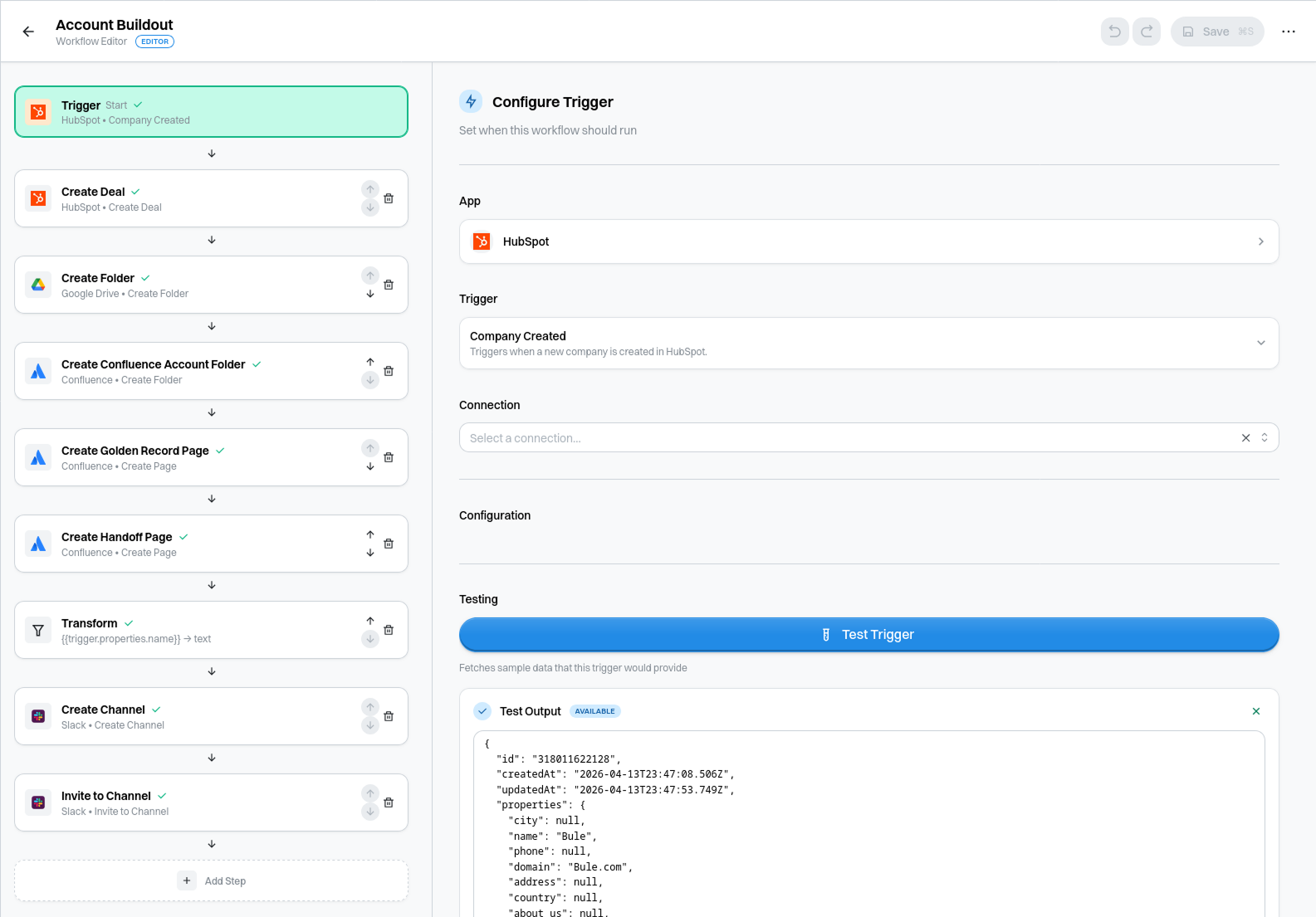
Integrations bring in context
Connect the CRM, docs, email, calendar, and collaboration systems where sales activity and customer knowledge already live.
Stitch turns that admin work into structured GTM workflows so your CRM, docs, and handoffs stay current from the calls, emails, and notes your team already creates.
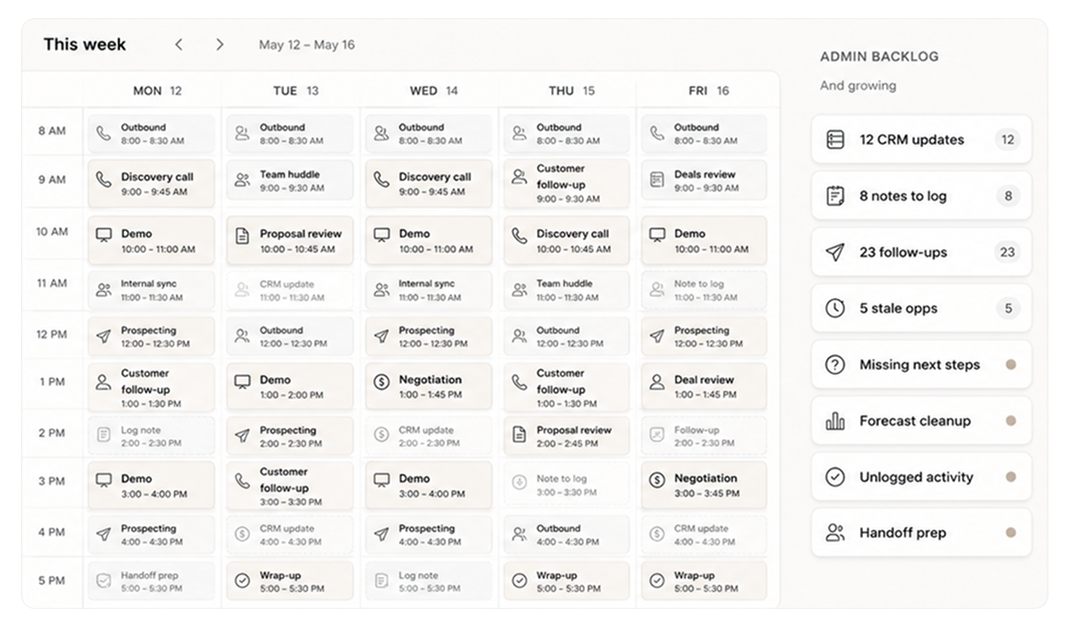
The backlog behind every sales week
The calls and demos are what matter. But notes, CRM updates, handoffs, and follow-ups keep stacking up around them.
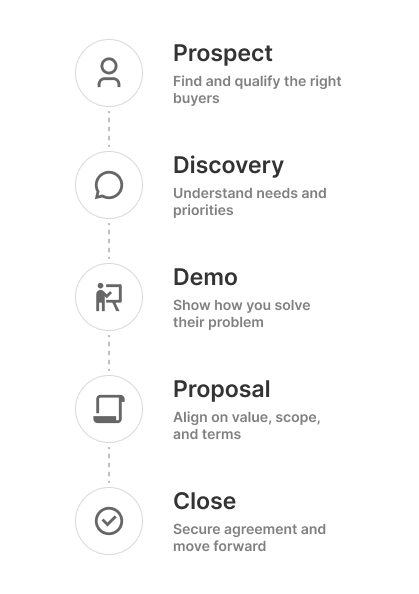
The moments that move the deal forward
Focus on the buyer journey and the interactions that drive decisions.
The rest is lost reconstructing context from calls, emails, docs, and Slack threads, then manually updating CRM records that are already out of date.
Opportunity fields drift. Handoffs lose meaning. Methodology data is incomplete. Managers inspect reports they do not fully trust. RevOps teams chase manual updates while generic automation tools break the moment context is missing.
† According to Salesforce's State of Sales report, the average rep spends just 28% of their week actually selling. The rest goes to CRM updates, internal syncs, and tool-hopping.
WHAT STITCH DOES
Important opportunity context is created in calls, emails, notes, docs, and team conversations. Stitch turns that activity into structured workflows that keep CRM, documentation, and downstream systems current.
It is not another chat window or a CRM replacement. Stitch gives GTM teams durable workflows, bounded agents, human approvals, and clear audit trails for the operational work that normally falls between tools.
Connect the CRM, docs, email, calendar, and collaboration systems where sales activity and customer knowledge already live.
Use triggers and ordered steps to move context, updates, handoffs, and follow-up through a repeatable operational path.
Add agents where the work needs interpretation, extraction, summarization, or proposed action, with explicit tools and limits.
Require review before sensitive agent actions apply, with justifications and audit trails attached to the workflow run.
Review opportunities, activity, readiness, and Stitch-originated changes in the context of the sales motion they support.
HOW IT WORKS
Stitch turns the work your team already does into a durable workflow: gather the context, run the right steps, ask for judgment where needed, and preserve the result.
Example Workflow Run
CompletedDiscovery call completed
01Opportunity context gathered
02Agent proposes CRM updates
03AE approves sensitive fields
04Docs and Slack handoff updated
05TRIGGER
A completed meeting, CRM change, email, or manual action can start the right workflow for the opportunity.
CONTEXT
The workflow can query CRM, docs, calendar, email, and collaboration tools so each step has the surrounding context it needs.
AGENT STEP
A bounded agent can extract goals, risks, stakeholders, next steps, or methodology criteria, then prepare proposed updates.
APPROVAL
When a tool requires approval, Stitch pauses the workflow and shows the proposed action with the agent's justification.
AUDIT TRAIL
Every trigger, step, agent run, approval, and downstream update is preserved so teams can see what changed and why.
USE CASES
Stitch helps teams build reusable GTM workflows around the moments that create admin drag: calls, handoffs, stage changes, follow-up, and review. Agents can handle judgment-heavy steps while the workflow keeps the process governed and traceable.
AFTER A CALL
Turn transcripts, notes, and related account context into a clean opportunity brief with goals, risks, stakeholders, requirements, and next steps.
BEFORE THE RECORD DRIFTS
Extract proposed field updates from sales activity, attach the supporting context, and route sensitive changes through approval before they apply.
WHEN THE TEAM NEEDS CONTEXT
Post the right summary to the right channel when an opportunity changes stage, a blocker appears, or a follow-up needs cross-functional attention.
AFTER THE MEETING ENDS
Prepare recap emails, mutual action plan updates, and next-step reminders from the same context used to update CRM and documentation.
BEFORE STAGE MOVEMENT
Check whether required methodology criteria are complete, identify missing information, and suggest the next question a seller should ask.
AS KNOWLEDGE CHANGES
Keep Google Docs, Confluence, Notion, or shared account notes aligned with the latest opportunity context instead of relying on stale handoff docs.
BEFORE KICKOFF
Compile the sales history, stakeholder map, open commitments, security status, and implementation notes the post-sale team needs to start cleanly.
FROM REAL BUYER SIGNALS
Capture feature requests, objections, and recurring requirements from calls and notes, then route them to the systems your product team already uses.
WHEN MANAGERS INSPECT THE WEEK
Review opportunity activity, readiness, recent updates, and Stitch-originated changes in the context of the pipeline motion they support.
READY TO PRESSURE TEST ONE?
Bring a call follow-up, CRM update, handoff, or review process. We will show where Stitch would gather context, route approvals, update systems, and leave an audit trail.
INTEGRATIONS
Stitch connects with the systems where sales activity, customer context, and operational work already live. Each integration can provide the building blocks a workflow needs.
Keep opportunity fields, activity, owners, stages, and methodology context aligned with the work happening around the customer.
 HubSpot
 Use meetings, messages, attendees, and follow-up as context for workflow runs instead of leaving them trapped in inboxes.
 Google Calendar
  Google Meet
 Route summaries, blockers, approval requests, and handoff updates to the channels where GTM teams already coordinate.
 Slack
Slack Keep account briefs, implementation notes, and shared documentation current as opportunity knowledge changes.
 Google Docs
  Google Drive
  Notion
  Confluence
 Move structured context into the trackers, project systems, and operational surfaces that support the GTM process.
 Google Sheets
  Jira
Jira Are we missing an integration you need? Let us know and we'll build it out and make sure it meets your needs.
WHAT CHANGES
Stitch does not replace the judgment of your sales team. It removes the repeated context gathering, copy/paste, follow-up routing, and record maintenance that surrounds every customer motion.
TODAY
Sellers hunt through CRM, notes, docs, Slack, and old emails to rebuild the account story before a call.
WITH STITCH
A workflow gathers recent activity, opportunity context, known gaps, and relevant documentation into one prep surface.
TODAY
Important details rely on memory, manual entry, and whatever a rep has time to update after the meeting.
WITH STITCH
An agent proposes structured CRM updates with supporting context, then routes sensitive changes through approval before they apply.
TODAY
Managers find missing criteria late, usually during inspection or forecast review, when the team is already under pressure.
WITH STITCH
Stitch checks readiness against your methodology and flags missing criteria with the next question or follow-up to resolve the gap.
TODAY
Notes split across transcripts, docs, Slack threads, spreadsheets, and individual memory until the shared record stops being useful.
WITH STITCH
Workflows merge new opportunity context into the right account documentation and preserve where the information came from.
TODAY
Post-sale teams receive a rushed summary, a few links, and a meeting where everyone tries to reconstruct months of sales context.
WITH STITCH
Stitch compiles stakeholders, commitments, risks, requirements, open questions, and recent activity into a handoff brief.
TODAY
Feature requests and objections stay buried in calls, notes, and internal threads, disconnected from the product systems that need them.
WITH STITCH
Relevant feedback can be captured from sales activity, grouped with account context, and routed into the team's product workflow.
TRUST AND CONTROL
GTM teams should not have to choose between manual admin and opaque AI. Stitch adds clear boundaries around agent work, requires human approval for sensitive changes, and preserves a complete record of what happened.
Agents operate with explicit instructions, allowed tools, and limits, so AI-assisted work stays inside the workflow you designed.
Require human review before important agent tool calls are applied. Reviewers can approve, reject, or request changes.
Agents explain why they proposed an action, giving reviewers the context they need before changes move downstream.
See which trigger started a workflow run, which steps ran, what changed, and who approved or triggered the work.
ADMIN COST MODEL
Admin drag is easy to feel and hard to size. This model turns GTM headcount, compensation, and tool sprawl into a directional view of trapped selling capacity, giving us a concrete starting point to validate against your CRM, workflows, and stack.
BASELINE
60% non-selling work
MODEL
35% recoverable admin
STACK
$85/tool/month
Your GTM team
84
RECOVERABLE HOURS / WEEK
That is 8.4 hours back each week per person in this conservative model.
$420K
TIME VALUE / YEAR
$31K
GTM SAAS OVERLAP / YEAR
See the model against your actual CRM and GTM stack.
Sources and assumptions. Salesforce's 2026 State of Sales report shows sales reps spend 60% of their week on non-selling work. HBR/Soroco research found workers spend just under four hours each week reorienting after toggling between applications. This model assumes a 40-hour week, a conservative 35% reduction of non-selling work, and $85/user/month with 50% potential overlap across GTM tools. It is a planning model, not a guaranteed outcome.
Stitch turns sales activity into structured GTM workflows. It connects the systems your team already uses, gathers context from real work, runs the right steps, invokes bounded agents where judgment is useful, and keeps sensitive changes reviewable through approvals, justifications, and audit trails.
No. Stitch sits around your CRM and the rest of your GTM stack. The goal is to keep systems of record, documentation, handoffs, and follow-up current without forcing every update to depend on manual entry.
Generic automation tools are useful for moving data between apps. Stitch is built for GTM workflows where opportunity context, methodology criteria, human review, agent justifications, and audit trails matter. It is designed for the work between CRM, docs, Slack, email, calendar, and operational systems.
Agents can be configured to propose changes instead of applying them directly. Sensitive actions can require approval, and every proposal includes the context and justification a reviewer needs to accept, reject, or request changes.
Stitch is designed around the activity sellers already create: calls, emails, notes, CRM changes, docs, and Slack conversations. The goal is to reduce the follow-up admin around that work, not add another place for sellers to maintain records.
We will map how Stitch would turn it into a governed workflow across your CRM, docs, calendar, email, Slack, and the other systems your team already uses.